From Reed Float to Modern Tackle: A Short Angling History
See how the fishing float changed from cut reed to moulded materials, and learn what those shifts reveal about tackle-making and angling craft.
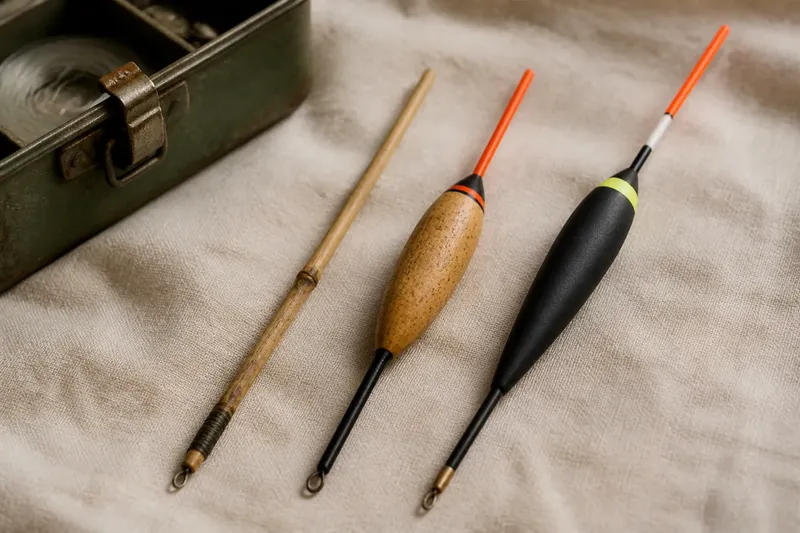
A fishing float’s shape records choices about materials, tools and the angler’s needs. The history of the fishing float is visible in a simple comparison: a reed stem cut beside the water and a brightly coloured modern float made to a repeatable pattern. Each does the same basic job, but the route from one to the other tells a story of changing craft rather than a steady march towards perfection.
To follow that story, imagine a clearly hypothetical angler called Ellen sorting through a relative’s tackle tin before a day on a quiet pond. She finds a slim reed float, a cork-bodied model and a modern insert-waggle float. By handling and comparing them, she can trace how makers worked with what they had, what they wanted the float to do and how closely they could reproduce a useful design.
Reed as raw material
The reed float begins with a plant stem: light, hollow and narrow enough to present little resistance when a fish moves the bait. An angler could select a suitable piece, trim it and attach a line fixing. The result depended on the reed’s natural form and the care taken in choosing and finishing it.
That dependence is not a flaw to be corrected. It is part of the object’s character. A slight curve, a difference in thickness or a change in buoyancy from one stem to another made each float an individual. The maker worked with the material, rather than asking it to conform exactly to a factory pattern.
Reed also made repair and replacement intelligible. If a float was damaged, an angler with suitable stems and a sharp knife could make another. That did not mean every bank offered the right material, or that every home-made float behaved alike. It did mean that the idea of the float could be carried in a method as much as in a purchased object.
Making buoyancy predictable
As tackle-making developed, makers used materials such as cork and wood to shape bodies with more control over their volume and outline. Cork could be cut and shaped; wood could be turned or carved. These materials allowed a maker to produce floats with deliberate proportions, then add a stem or fixing suited to the intended use.
The change was not simply from crude to refined. A cork-bodied float might offer buoyancy and a visible tip, while a slim reed could be more delicate and simple to replace. The useful choice depended on the water and presentation. The important historical shift was that the maker had more ways to define the body, rather than relying on the natural dimensions of a plant stem.
More controlled shaping also encouraged recognisable forms. Anglers could ask for a float with a particular body, stem or fixing, and makers could respond with a design that was easier to describe and reproduce. The object began to carry an expectation: not merely “a float”, but a type with a known purpose and a familiar feel.
From handwork to repeatable parts
Modern floats often combine materials selected for particular jobs. A body may be moulded from plastic or made from another manufactured material, while stems and visible tips use different components. Fixings can be formed to accept line in a consistent way. This allows a maker to produce a recognisable model without depending on the quirks of a single reed or piece of cork.
Repeatability changes the angler’s relationship with tackle. When two floats share a design, an angler can expect them to be broadly similar in shape and use. That makes replacing a lost float less like starting over. It also lets makers offer distinct patterns for different presentations, from a fine-tipped float for delicate work to a more buoyant model suited to a different setting.
Yet standardisation has its own limits. A factory-made float may be consistent, but consistency does not decide whether it suits a particular swim. Nor does a modern material automatically make a float better for every purpose. The craft lies in matching the object to the task, not in choosing the newest item by default.
Ellen’s tackle tin
Say Ellen lays the three floats on a clean cloth and examines them before fishing. The reed is slim and slightly uneven; the cork float has a shaped body and a visible stem; the modern model has a moulded body and a sharply defined tip. She does not treat the objects as a ranking. Instead, she asks what each design makes possible and what it asks of its user.
At the pond, she chooses the modern float because its clear tip is easy to follow against the bank’s dark reflection. She keeps the reed float in the tin as a reminder that the essential idea predates the materials around it: a buoyant marker, attached to the line, that helps an angler interpret movement. The expected result is practical rather than dramatic: she can see the chosen float clearly, while understanding that another model might better suit a different position or presentation.
That small decision draws a useful lesson from the history. A change in materials affects more than appearance. It can alter how a float is made, repaired, replaced, described and selected. But the angler still has to read the conditions and decide what the tackle is for.
What the materials reveal
Comparing old and new floats is a way to notice the work hidden inside ordinary tackle. Look for the body material, how the stem joins it, whether the line fixing is integral or added, and how the maker has made the tip visible. Each detail points to a choice about production or use.
- Natural reed: notice the stem’s own shape and the individual variation that comes with it.
- Cork or wood: look for a shaped body that reflects deliberate cutting, carving or turning.
- Manufactured body: check for a repeated outline and a consistent finish.
- Stem and tip: observe whether separate parts have been joined to give the float a particular balance or visibility.
- Fixing: see how the float connects to the line and whether that arrangement looks easy to alter or replace.
It is not worth trying to date every float from colour or finish alone. Faded paint, repairs and later modifications can disguise a model’s original appearance. The more dependable exercise is to compare construction and ask what the material allowed the maker to do.
Questions anglers still ask?
Why were reed floats popular?
Reed was light, naturally buoyant and available to anglers who could select and trim suitable stems. Its appeal came from practical simplicity, though natural variation meant no two pieces needed to be identical.
What changed when makers used cork?
Cork gave makers a material they could shape into a deliberate body, rather than relying entirely on a plant stem’s form. That widened the range of outlines and buoyancy choices available to anglers.
Are modern floats always better?
No. Manufactured materials can make designs consistent and easy to replace, but a float’s suitability depends on the presentation and conditions. An older or simpler pattern can still be the sensible choice for a particular kind of fishing.
What does a float’s construction tell me?
It can suggest how the float was made, how its parts were joined and which qualities its maker prioritised. Treat those clues as evidence of craft, not as a precise date or a full account of the object’s history.
A small object, lasting craft
The fishing float remains a useful lens on angling history because its purpose is easy to understand while its making has changed markedly. Reed, cork, wood and manufactured materials each brought different possibilities, and each left its mark on the finished object.
Next time you open a tackle tin, compare a float’s material with the job you want it to do. That simple act connects present-day tackle choice to the hands and methods that shaped earlier designs, without asking the newest model to tell the whole story.